Mastering wide-area air quality monitoring technology through LoRa/IoT
As air pollution becomes an increasingly urgent challenge in urban and industrial areas, developing domestic capabilities in environmental monitoring technology holds significant scientific and practical importance. In response to this need, Dr. Nguyen Van Thien and his research team at Hanoi University of Industry undertook a ministerial-level project assigned by the Ministry of Industry and Trade: “Research and design of a large-scale AQI monitoring system based on LoRa/IoT technology,” implemented from April 2021 to December 2022, with the goal of developing a commercially viable solution.
An integrated monitoring system
According to Dr. Nguyen Van Thien, rapid urbanization and industrialization are placing increasing pressure on air quality. Fine particulate matter and hazardous gases have become pressing concerns, requiring not only emission control but also accurate, continuous, and wide-area monitoring systems.
Currently, most monitoring systems in Vietnam rely on imported equipment, which entails high investment and maintenance costs, limiting the expansion of monitoring networks.
To address this challenge, the research team adopted a strategic approach by developing a large-scale AQI monitoring system based on LoRa/IoT technology, aiming to achieve technological autonomy and enable commercialization.
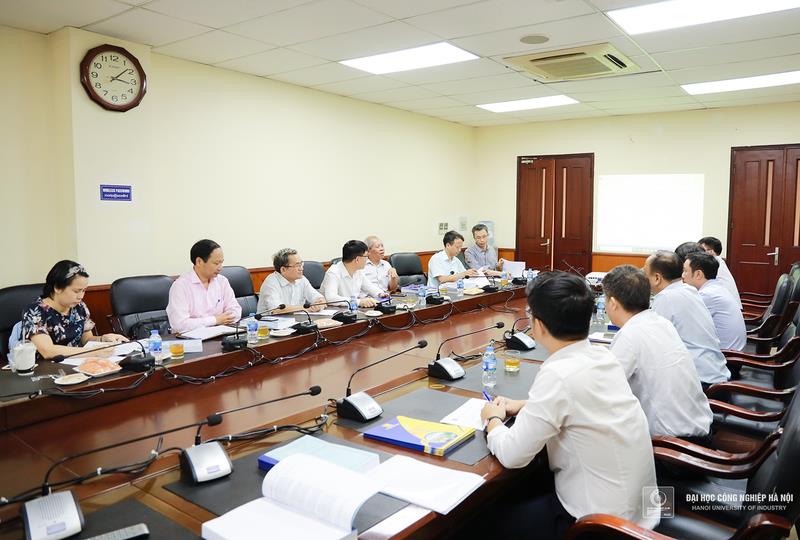
Scientific and Technological Research Project Evaluation Panel at the Ministry Level. Photo: HaUI
The system is designed as an integrated solution combining hardware and software, capable of real-time environmental data acquisition and AQI calculation in accordance with Vietnamese standards. It simultaneously measures key parameters, including CO, NO₂, SO₂, O₃ concentrations, PM2.5 and PM10 levels, as well as temperature and humidity. The processed data are used to assess and provide warnings on air quality conditions, serving as a vital communication tool for the public.
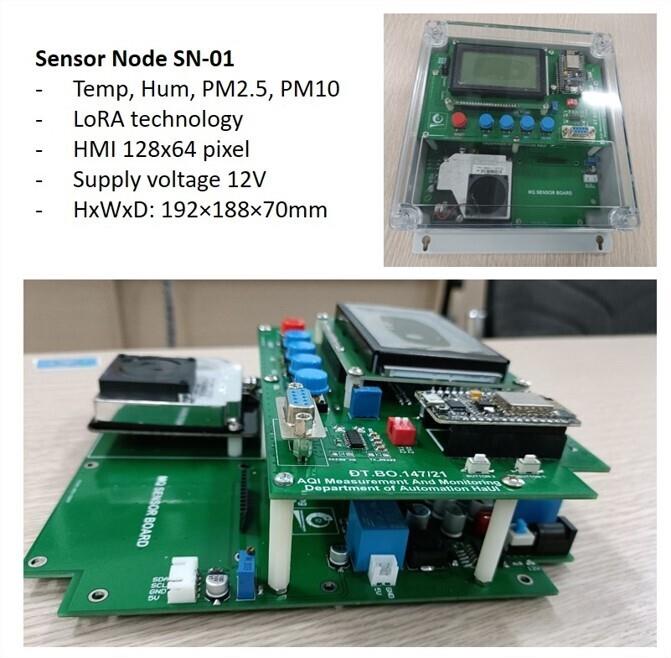
Sensor Node SN-01 hardware
Structurally, the system employs a wireless sensor network based on LoRa combined with IoT, enabling the connection of multiple monitoring points across a wide area with low power consumption and cost efficiency. The system architecture includes sensor modules, routers and central gateways, Internet/3G/4G data transmission platforms, on-site HMI interfaces, and a web-based SCADA system.
The software architecture consists of three layers: embedded software on ARM microcontrollers for data acquisition and processing; configuration and testing software for the LoRa network; and a SCADA system developed using Java/SQL, enabling remote monitoring and management.
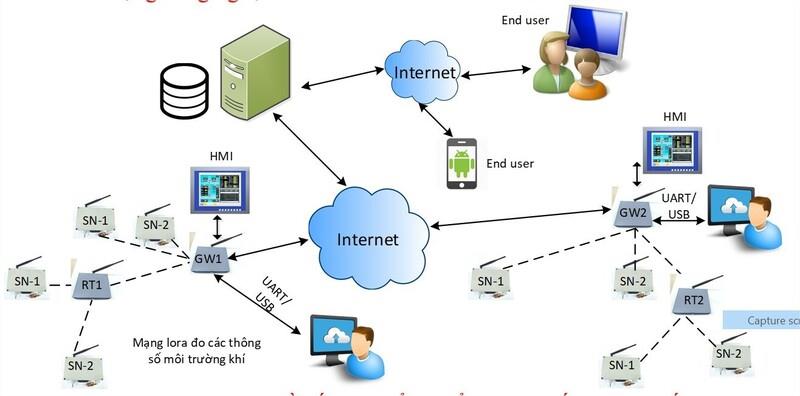
Monitoring network structure. Photo: HaUI
Notably, users can access the system anytime and anywhere via the Internet, including on mobile devices. This feature enables seamless integration with smart city operation centers and local environmental management systems. Testing results demonstrate stable operation, reliable data transmission, and full compliance with automated monitoring requirements.
Towards Commercialization and Practical Application
Dr. Nguyen Van Thien emphasized that the project’s core value lies not only in its technical output but also in advancing domestic technological capability. The system is designed to cost approximately 50% of equivalent imported solutions, making it highly suitable for large-scale deployment in urban areas, industrial zones, and production facilities.
By utilizing a 32-bit ARM platform, open-source software, and LoRa/IoT technology, the system offers high flexibility, ease of maintenance and upgrading, and compatibility with domestic manufacturing capabilities—key prerequisites for commercialization and scalability.
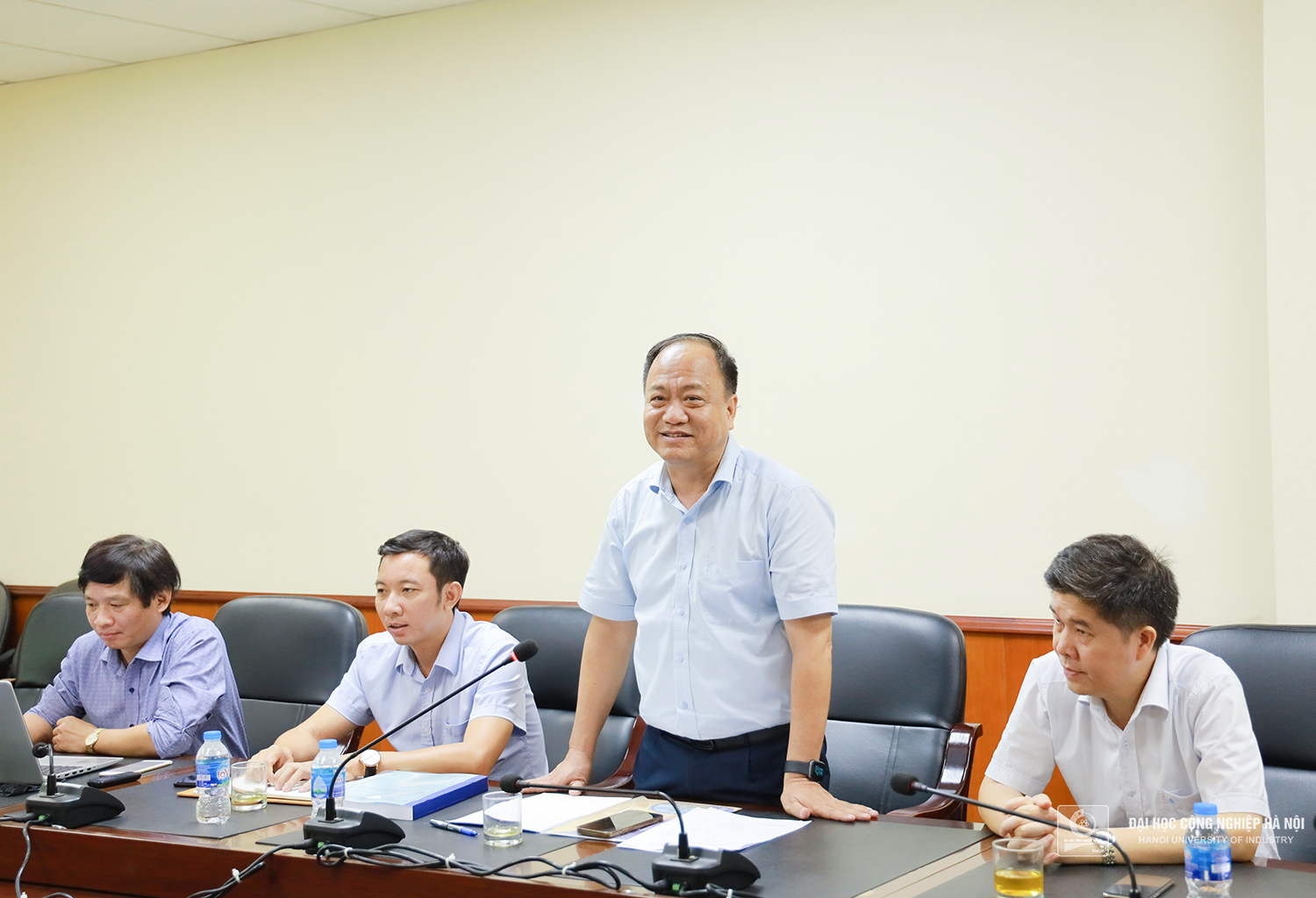
Dr. Nguyễn Văn Thiện, Project leader, presenting to the Evaluation Council. Photo: HaUI
The system has been piloted across various locations within the Hanoi University of Industry campus, including workshops, classrooms, offices, and outdoor areas, allowing the research team to refine operational processes and assess long-term stability.
Moving forward, the team aims to collaborate with enterprises to bring the product to market. A cost-effective, domestically developed monitoring system will enable industrial zones, schools, hospitals, and smart cities to implement proactive environmental monitoring solutions.
In the context of digital transformation and smart city development, the system is expected to be integrated into provincial and municipal environmental management platforms, contributing to more effective environmental governance.
-
Friday, 16:41 30/01/2026
Related news
Hot News
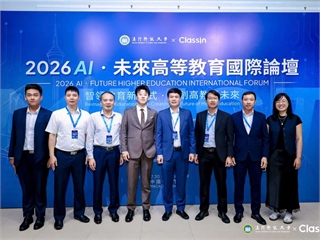
HaUI expands partnerships in Education, Research and Digital Transformation in China
Chủ Nhật, 09:09 02/08/2026

Related news
HaUI and QAA exchange expertise on international quality assurance and accreditation
Thứ Ba, 07:35 13/10/2026
HaUI expands academic partnerships in Japan at the Fourth Japan- Vietnam University Presidents’ Conference
Thứ Sáu, 18:05 09/10/2026
Three HaUI scientists advance in the 2026 World’s Most Influential Researchers Rankings
Thứ Sáu, 07:59 09/10/2026
HaUI and Palestinian partners explore new avenues for education and research
Thứ Sáu, 15:55 02/10/2026
HaUI consolidates student affairs achievements and advances support initiatives
Thứ Tư, 16:40 28/01/2026
HaUI strengthens digital transformation: Achievements in 2025 and roadmap for 2026
Thứ Hai, 10:51 26/01/2026
“Warm Winter in the Highlands”: HaUI youth writing stories of kindness in Tan Mai
Thứ Sáu, 13:55 23/01/2026
HaUI announces new research group model to drive innovation and technology transfer
Thứ Tư, 14:45 07/01/2026
Hanoi University of Industry hosts training workshop on internal documentation and university governance
Thứ Tư, 08:34 31/12/2025